UPSC CSE Law Optional

LAW OPTIONAL FOUNDATION

2027

A structured, mentor-led Law Optional Foundation program by ForumIAS Academy designed to build conceptual clarity, exam-oriented answer writing, and command over Paper I & Paper II.

Starts
17JULY
Online | Offline
350+ hrs classes

Comprehensive classes to cover core concepts of Law Optional Paper I & II.

Comprehensive notes

Class notes along with references to additional credible study material.

Test series included

Sectional and full-length tests for regular assessment and consolidation.

Legal developments

Coverage of landmark judgments, policy initiatives, and relevant legal updates.

Answer writing practice

Regular answer writing through 35 mini tests comprising 7 questions each.

Personalized mentorship

Individualized guidance and mentoring support with faculty.

Your Pathway to Preparedness

Equipped for success.

“Welcome to the vibrant world of Law.” The Law Foundation Program at ForumIAS offers a dynamic and structured approach to mastering the lively and stimulating field of Law, in tune with the rigorous demands of the UPSC CSE syllabus.

Led by experienced faculty members who are experts in Law and well-versed with the intricacies of the UPSC CSE exam pattern, classroom sessions are carefully curated to cover all aspects of the Law syllabus.

What makes the program effective?

  • Engaging lectures and interactive discussions.
  • Meticulous engagement with PYQs.
  • Practical exercises for conceptual clarity.
  • Coverage of legal provisions, case laws and frameworks.
  • Retention-focused, answer-oriented preparation.
Regular Assessment

Tracking Progress, Shaping Futures

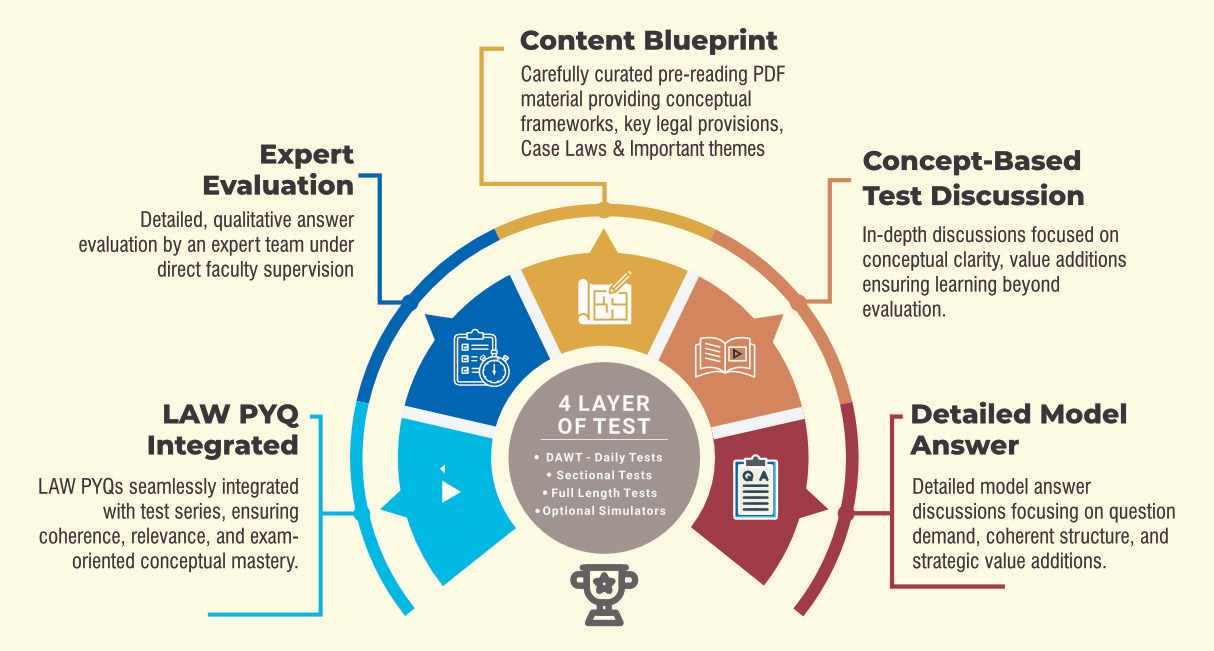
Regular assessment plays a crucial role for UPSC CSE Law Optional aspirants. ForumIAS integrates a layered test and evaluation approach for conceptual mastery and exam readiness.

assessment
Handouts

Your hand held Guide to success

Handouts in a LAW class for UPSC CSE preparation provide concise and comprehensive summaries of key concepts, theories, provisions and thinkers relevant to the exam.

Helping students develop comprehensive study plans covering all Law topics, prioritizing as per UPSC pattern and trends.

Summarize important legal principles, landmark cases, constitutional provisions and doctrines in exam-oriented format.

Provide important materials and case laws on Previous Years’ Questions, PYQs.

Providing illustrations and explanation of important case facts along with majority and minority judgments.

Supplement Bare Acts with explanations for better clarity and application.

Notes provided in explanatory and answer-oriented format.

Our Faculty

MR. NAWEED AKHTER

Faculty, Law Optional

He is an experienced professional in the legal field with Masters in Law, LL.M, from National Law School of India University, Bangalore. He has been mentoring and teaching civil services aspirants for 10 years, with a proven track record of guiding successful candidates. His teaching is based on an exam-oriented approach by simplifying legal concepts, connecting legal principles with current developments and case laws.

Nurturing Potential

Guiding Success: Your journey with a mentor

Regular and customized mentorship greatly benefits students preparing for UPSC CSE. The Law Foundation Program at ForumIAS provides guidance, support and personalized advice tailored to individual needs.

Study Planning & Strategy

Comprehensive study plans covering Law topics, prioritization as per UPSC pattern and scheduling revision.

Performance Review & Feedback

Regular feedback on mock tests and assessments with strategies and resources for improvement.

Mentorship & Motivation

Motivational support to keep students focused and positive throughout their preparation.

Fees Structure

Choose Your Course Variant

Course Variant Online Only Offline + Online
Law Foundation 2027
Classes Only
₹ 40,120/- Enroll Now ₹ 44,480/- Enroll Now
Law Foundation 2027
Classes + Test Series
₹ 47,200/- Enroll Now ₹ 49,914/- Enroll Now

In case of hybrid mode, fees will be INR 4,000/- over and above the fees for offline mode.

Fee Concession
  • Old/Existing Students of GS Foundation Program can get the course at INR 38,500/- online mode and INR 46,500/- offline mode. Fees are for Foundation classes only and not Test Series.
  • Old/Existing ForumIAS students of Law Optional Foundation can avail a fee concession of 15% on Law Optional Foundation 2027.
  • Students of all programs can avail fee concession of 10% on Law Optional Foundation 2027.
  • All concessions can be availed by sending an email to admissions@forumias.academy.
Fee Payment & Enrollment

How to enroll?

  • By visiting academy.forumias.com and paying via Net Banking,DebitCard
    /Credit Card or UPI.
  • By NEFT or Cash Deposit in HDFC Bank Accounts.
    Email admissions@forumias.academy for this option.
  • By visiting the Offline Guidance Center and paying via Card, Cheque or DD.
  • Queries: call +91 93117 40400, WhatsApp +91 93117 40404 or
    write to Optionals@forumias.academy.
Terms & Conditions
  • A physical ID card (nominal fee Rs. 30) is required for offline services.
  • Test copies evaluated within 10 working days of submission.
  • Copies must be submitted within three weeks of test release.
  • Fees are non-refundable and the course is non-transferable.
  • The course is valid till 31 December, 2027.
  • No sharing of programs; ForumIAS may terminate access for misuse.
  • ForumIAS may close admissions and amend schedules in exigencies.
Foundation Classes For Law Optional

Class Details & Syllabus Bifurcation

Law Optional comprises subjects divided under Paper I and Paper II, further divided into Section A and Section B. The Foundation Course has been designed to ensure conceptual clarity along with discussion on key judgments.

Purpose of Foundation Classes
  1. Expert Guidance: Clarify complex legal concepts and address doubts with examples and case laws.
  2. In-depth Understanding: Develop a strong conceptual foundation in law subjects.
  3. Structured Preparation: Clear roadmap and organized study plan aligned with UPSC syllabus and pattern.
  4. Study Materials: Study materials are part of the Foundation Course.
Paper-wise Bifurcation
PAPER-I
Section-A Section-B
  • Constitutional Law
  • Administrative Law
  • International Law
PAPER-II
Section-A Section-B
  • Law of Crimes
  • Law of Torts
  • Consumer Protection Act
  • Prevention of Corruption Act, 1988
  • SC & ST (Prevention of Atrocities) Act
  • Law of Contracts
  • Sale of Goods and Hire Purchase
  • Formation and Dissolution of Partnership
  • Arbitration and Conciliation Act, 1996
  • Negotiable Instruments Act, 1881
  • Contemporary Legal Developments

Timeline Topic
Class-1 Constitution and Constitutionalism: Distinctive features + PIL, Article 32
Class-2 Basic Structure + Amendment of the Constitution + Relationship between FR, DPSP and FD
Class-3 Article 31A, 31B, 31C + Eminent Domain, State/common/community property
Class-4 Fundamental Rights - Article 12, 13
Class-5 Distribution of Legislative Powers between the Union and the States
Class-6 Fundamental Rights - Article 14, 15 and 16
Class-7 Fundamental Rights - Article 19
Class-8 Fundamental Rights - Article 20, 21 and 22
Class-9 Fundamental Rights - Article 20, 21 and 22
Class-10 Fundamental Rights - Article 25-28
Class-11 Fundamental Rights - Article 29-30
Class-12 Legal Aid + Legal Services Authority
Class-13 Constitutional Position of the President & Council of Ministers
Class-14 Governor and his Powers + Article 356
Class-15 Other Emergency Provisions - Article 352 + 360
Class-16 Supreme Court and High Courts - Powers, Functions, Appointment & Transfer
Class-17 Administrative Tribunals
Class-18 Services under Union & States + UPSC and SPSC powers and functions
Class-19 Election Commission - Power and functions
Class-20 Legislative Powers, Privileges and Immunities
Class-21 Administrative relationship among Union, State and Local Bodies
Class-22 Local Bodies

Timeline Topic
Class-1 Principle of Natural Justice
Class-2 Principle of Natural Justice
Class-3 Delegated legislation and its constitutionality
Class-4 Delegated legislation and its constitutionality
Class-5 Separation of Powers and Constitutional Governance
Class-6 Judicial Review of Administrative Action
Class-7 Judicial Review of Administrative Action
Class-8 Ombudsman: Lokayukta, Lokpal etc.

Timeline Topic
Class-1 Nature and Definition of International Law - Part 1
Class-2 Relationship between International Law and Municipal Law
Class-3 Sources of International Law - Part 1
Class-4 International Treaty - Part 1
Class-5 International Treaty - Part 2
Class-6 State Recognition
Class-7 State Succession
Class-8 Territorial jurisdiction of States
Class-9 Individuals: Nationality, Statelessness
Class-10 International Human Rights
Class-11 Extradition and Asylum
Class-12 Lawful Recourse to Force: Aggressions, Self-defence, Intervention
Class-13 Law of the Sea - Part 1
Class-14 Law of the Sea - Part 2
Class-15 United Nations: Organs, powers, functions and reform - Part 1
Class-16 United Nations: Organs, powers, functions and reform - Part 2
Class-17 Peaceful settlement of disputes - different modes
Class-18 Fundamental principles of International Humanitarian Law
Class-19 Legality of the use of Nuclear Weapons
Class-20 International Terrorism, State sponsored terrorism, Hijacking
Class-21 International Criminal Court
Class-22 New International Economic Order and Monetary Law - Part 1
Class-23 New International Economic Order and Monetary Law - Part 2
Class-24 Protection and Improvement of the Human Environment

Timeline Topic
Class-1 Concepts of Criminal Law - mens rea and actus reus, mens rea in statutory offences
Class-2 Kinds of punishment and trends on abolition of capital punishment
Class-3 Preparations and Criminal Attempt
Class-4 General Exceptions - Part 1
Class-5 General Exceptions - Part 2
Class-6 Right of Private Defence
Class-7 Joint and Constructive Liability
Class-8 Offences against Public Tranquillity
Class-9 Offences against Public Tranquillity
Class-10 Abetment & Criminal Conspiracy
Class-11 Offences Against State
Class-12 Offences against Human Body - Part 1
Class-13 Offences against Human Body - Part 2
Class-14 Offences against Property
Class-15 Offences against Women - Part 1
Class-16 Offences against Women - Part 2
Class-17 Prevention of Corruption Act, 1988
Class-18 Prevention of Corruption Act, 1988
Class-19 Protection of Civil Rights Act, 1955
Class-20 Plea Bargaining

Timeline Topic
Class-1 Nature and Definition of Torts
Class-2 Liability Based upon Fault and Strict Liability + Absolute liability
Class-3 Vicarious liability
Class-4 Vicarious liability of State
Class-5 General defences - Part 1
Class-6 General defences - Part 2
Class-7 Joint Tort Feasors
Class-8 Remedies Available Under Torts
Class-9 Negligence
Class-10 Nuisance - Public and Private + Trespass
Class-11 Defamation
Class-12 False Imprisonment and Malicious Prosecution
Class-13 Consumer Protection Act, 2019

Timeline Topic
Class-1 Nature and formation of contract + E-contract
Class-2 Postal Rule of Communication + E-contract
Class-3 Factors Vitiating Free Consent
Class-4 Void, voidable, illegal and unenforceable agreements - Part 1
Class-5 Void, voidable, illegal and unenforceable agreements - Part 2
Class-6 Performance and Discharge of Contracts - Part 1
Class-7 Performance and Discharge of Contracts - Part 2
Class-8 Breach of Contract and Consequences - Part 1
Class-9 Breach of Contract and Consequences - Part 2
Class-10 Quasi-Contract
Class-11 Standard Form Contract
Class-12 Contract of Indemnity, Guarantee and Insurance - Part 1
Class-13 Contract of Indemnity, Guarantee and Insurance - Part 2
Class-14 Contract of Agency
Class-15 Sale of Goods and Hire Purchase - Part 1
Class-16 Sale of Goods and Hire Purchase - Part 2
Class-17 Formation and Dissolution of Partnership - Part 1
Class-18 Formation and Dissolution of Partnership - Part 2
Class-19 Negotiable Instruments Act, 1881 - Part 1
Class-20 Negotiable Instruments Act, 1881 - Part 2
Class-21 Arbitration and Conciliation Act, 1996 - Part 1
Class-22 Arbitration and Conciliation Act, 1996 - Part 1
Class-23 Mediation Act, 2023

Timeline Topic
Class-1 Intellectual property rights - Concept, types/prospects - Part 1
Class-2 Intellectual property rights - Concept, types/prospects - Part 2
Class-3 Intellectual property rights - Concept, types/prospects - Part 3
Class-4 Information Technology Law including Cyber Laws - Part 1
Class-5 Information Technology Law including Cyber Laws - Part 2
Class-6 Competition Law - Concept, purpose/prospects - Part 1
Class-7 Competition Law - Concept, purpose/prospects - Part 2
Class-8 Major Statutes Concerning Environmental Law - Part 1
Class-9 Major Statutes Concerning Environmental Law - Part 2
Class-10 Right to Information Act - Part 1
Class-11 Right to Information Act - Part 2
Class-12 Trial by Media